
TRT has gone from a niche treatment to a dinner-table topic. Friends talk about it, podcasts promote it and online clinics advertise it everywhere. But what is TRT, really? Who actually needs it, what does it do, and what are the trade-offs?
This guide answers those questions in plain language, using the latest clinical guidelines and research. Think of it as your starting point. Each section links to a deeper guide if you want more detail.
| The short answer: what is TRT? TRT stands for testosterone replacement therapy. It’s a prescription treatment that restores testosterone to a normal range in men whose bodies don’t make enough. It comes as injections, gels, pellets, oral capsules and more. TRT is meant for men with confirmed low testosterone and symptoms, not for boosting normal levels, and it requires regular lab monitoring. |
Key Takeaways
- TRT replaces testosterone your body isn’t making enough of. It aims for a normal range, not a high one.
- Diagnosis requires symptoms plus two early-morning blood tests showing low testosterone.
- In large trials, TRT modestly improved sexual function, mood, bone density and anemia.
- A 2023 trial of 5,246 men found no increase in heart attack or stroke risk.
- TRT can raise blood pressure and red blood cell counts, and it can lower sperm production.
- Safe TRT means ongoing labs and follow-up, not a one-time prescription.
What Is TRT and What Does Testosterone Do?
Testosterone is the main male sex hormone. It supports sex drive and erections, muscle and bone strength, red blood cell production, energy and mood. Most testosterone is made in the testes, under signals from the pituitary gland in the brain.
When that system doesn’t produce enough, the condition is called hypogonadism, or low T. Testosterone replacement therapy supplies the hormone from outside the body to bring levels back into a healthy range.
FDA approves testosterone for men who have low levels along with an associated medical condition. Its labels note that benefit in age-related low testosterone alone hasn’t been established (FDA).
Who Is TRT For?
Testosterone replacement therapy is for men with both symptoms and lab-confirmed low testosterone. The American Urological Association (AUA) uses a total testosterone below 300 ng/dL as a reasonable cutoff, confirmed with two early-morning tests on separate days (AUA guideline summary).
The symptoms most closely tied to low T are fewer morning erections, low sex drive and erectile dysfunction. Fatigue, low mood and reduced stamina can also be part of the picture. Read low testosterone symptoms men often ignore for the full list, and our guide to men’s health blood work for how to get tested.
Testosterone therapy generally isn’t the right first choice if you:
- Want to father children soon, since TRT can suppress sperm production
- Have normal testosterone and want to feel or perform better
- Have untreated causes like severe sleep apnea, obesity or medication effects that might be addressed first
Types of TRT: How Testosterone Is Delivered
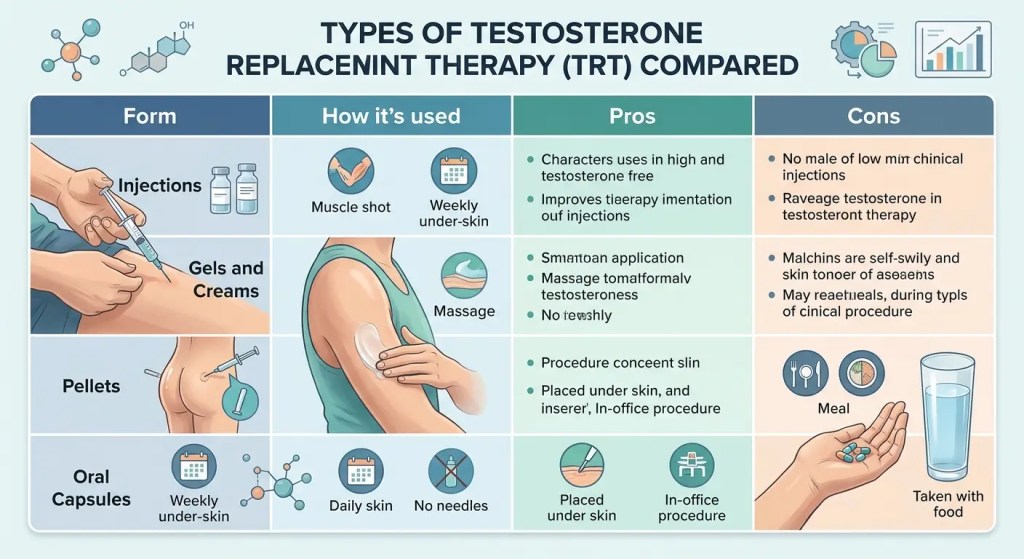
Common forms of testosterone replacement therapy
| Form | How it’s used | Pros | Cons |
| Injections | Into a muscle every 1 to 4 weeks (every 10 weeks in a clinic for one type), or weekly under the skin | Reliable; easy to adjust; generic options | Levels rise and fall; raises hematocrit most often |
| Gels and creams | Rubbed on the skin daily | Steadier levels; no needles | Daily routine; can transfer to partners or children through skin contact |
| Pellets | Placed under the skin every few months | No daily or weekly dosing | Minor in-office procedure each time |
| Oral capsules | Testosterone undecanoate, taken by mouth | No needles or skin contact | Taken with food; blood pressure warnings |
| Nasal gel | Applied inside the nose several times a day | Short-acting | Frequent dosing |
Sources: Sexual Medicine (hematocrit by form), oral testosterone review.
New to shots? Read our injectable testosterone beginner’s guide. At About Face, our bioidentical hormone replacement therapy program uses Biote pellets, which typically last three to five months. Read our testosterone pellets guide to see how they work.
What Are the Benefits of TRT? What the Research Shows
The best evidence comes from the Testosterone Trials, a set of one-year studies in 790 men aged 65 and older with low testosterone and symptoms. Compared with placebo, testosterone (MDedge; Penn Medicine):
- Improved sexual function, including sexual activity, desire and erections
- Modestly improved mood, with more positive and fewer negative feelings
- Increased bone density and estimated bone strength
- Raised hemoglobin and corrected anemia, including in men with no other identifiable cause
Some results were less impressive. The main vitality outcome didn’t improve, the main walking test wasn’t significantly better, and testosterone didn’t improve memory or thinking. The researchers described the benefits as small to moderate.
In other words, testosterone replacement therapy can meaningfully help the right patients, but it isn’t a fountain of youth.
Is TRT Safe? Risks and Side Effects
The biggest safety question for years was the heart. The TRAVERSE trial tested it in 5,246 men aged 45 to 80 with low testosterone and heart risk factors. Major heart events occurred in 7.0% of men on testosterone and 7.3% on placebo (TCTMD). In February 2025, FDA removed the cardiovascular risk language from the boxed warning on testosterone products and added a class-wide warning about increased blood pressure (FDA).
Other risks to know about:
- Higher hematocrit (thicker blood). Endocrine Society guidance calls for holding therapy if it rises above 54% (MDedge).
- Heart rhythm and clots. In TRAVERSE, atrial fibrillation, acute kidney injury and pulmonary embolism were somewhat more common on testosterone.
- Lower sperm production and smaller testes (Healio).
- Acne, oily skin and fluid retention.
- Faster hair thinning in men prone to pattern baldness. See does TRT cause hair loss?
In the Testosterone Trials, men on testosterone also had more coronary artery plaque on CT scans, though the study was too small to know what that means clinically (Penn Medicine). That’s one more reason testosterone therapy should always come with follow-up.
TRT vs. Anabolic Steroids
Both involve testosterone, but they’re very different. TRT uses doses designed to bring low testosterone back into a normal range, under medical supervision with regular labs. Anabolic steroid use for bodybuilding typically involves doses far above natural levels, often without medical oversight and sometimes with products from illegal sources.
Testosterone is a Schedule III controlled substance. Legitimate testosterone replacement therapy always starts with a prescription from a licensed provider and a licensed pharmacy.
What to Expect When You Start TRT
Results build gradually. Many men notice changes in energy, mood or libido within the first several weeks, while effects on body composition and bone take months. The Testosterone Trials measured results over a full year.
A typical monitoring schedule
| When | What happens |
| Before starting | Two morning testosterone tests, blood count (hemoglobin and hematocrit), PSA when appropriate, fertility discussion |
| 3 to 6 months | Symptom review, testosterone level, hematocrit and blood pressure |
| Every 6 to 12 months | Testosterone level, as recommended by the AUA, plus hematocrit |
| First year | PSA checks; a rise of more than 1.4 ng/mL or a level above 4 ng/mL calls for a urology review |
Sources: AUA guideline summary, Endocrine Society summary.
If your levels return to normal but your symptoms don’t improve within 3 to 6 months, the AUA recommends discussing whether to stop therapy (AUA guideline summary).
Alternatives to TRT
Testosterone therapy isn’t the only path. For men with borderline levels, losing excess weight and improving sleep can raise testosterone meaningfully. Most over-the-counter “testosterone boosters” lack good evidence. Compare every option in our guide to low testosterone treatment: TRT vs. natural boosters, and see how our medically guided weight loss program can help.
Is TRT for Life?
Not necessarily, but TRT treats low testosterone rather than curing it. If you stop, symptoms usually return, and your body’s own production can take time to recover because outside testosterone signals the testes to slow down. Some men whose low T was driven by weight or sleep problems can come off therapy after fixing those causes. Any plan to stop should be made with your provider.
TRT in Stratham, NH
At About Face — A Well Labs+ Medspa, testosterone therapy starts with testing, not guesswork. Your consultation includes a review of your symptoms and history and a thorough hormone panel, with in-office concierge lab draws. If your levels are low, we’ll explain your options and build a personalized plan, including Biote pellet hormone replacement therapy with ongoing monitoring.
Women need testosterone too, at much lower levels. Learn about our hormone therapy for women, or read our guide on whether hormone replacement therapy is right for you.
We welcome patients from Stratham, Portsmouth, Exeter and across the New Hampshire Seacoast at 64 Portsmouth Ave, Suite 4. Meet our team, book a virtual consultation, or call (603) 580-5296.

| Wondering if TRT is right for you? Book your hormone consultation and in-office lab draw at About Face — A Well Labs+ Medspa in Stratham today. |
Frequently Asked Questions
What does TRT stand for?
TRT stands for testosterone replacement therapy. It’s a prescription treatment that restores testosterone to a normal range in men with confirmed low levels.
Is TRT the same as taking steroids?
No. TRT uses doses meant to bring low testosterone back to normal, with medical supervision and regular labs. Anabolic steroid use typically involves much higher doses without medical oversight.
How long does TRT take to work?
Many men notice changes in energy, mood and libido within the first several weeks. Changes in body composition and bone density take months. Your provider reviews progress around 3 to 6 months.
Is TRT safe?
For men with confirmed low testosterone and proper monitoring, testosterone replacement therapy is generally considered safe. A 2023 trial found no increase in heart attack or stroke risk, but TRT can raise blood pressure and hematocrit and lower sperm production, so regular labs matter.
What is TRT’s effect on fertility?
TRT can reduce or stop sperm production because it signals the testes to slow down. Men who want children should discuss fertility-preserving options before starting.
Can women use TRT?
Women can use testosterone at much lower doses than men. A 2019 global consensus statement found that doses keeping women’s levels in the normal premenopausal range weren’t linked to hair loss, though some women noticed mild acne or extra body hair.
Do I have to stay on TRT forever?
Not always. Symptoms usually return if you stop, and natural production may take time to recover. Some men can stop after addressing causes like excess weight or poor sleep. Make that decision with your provider.