
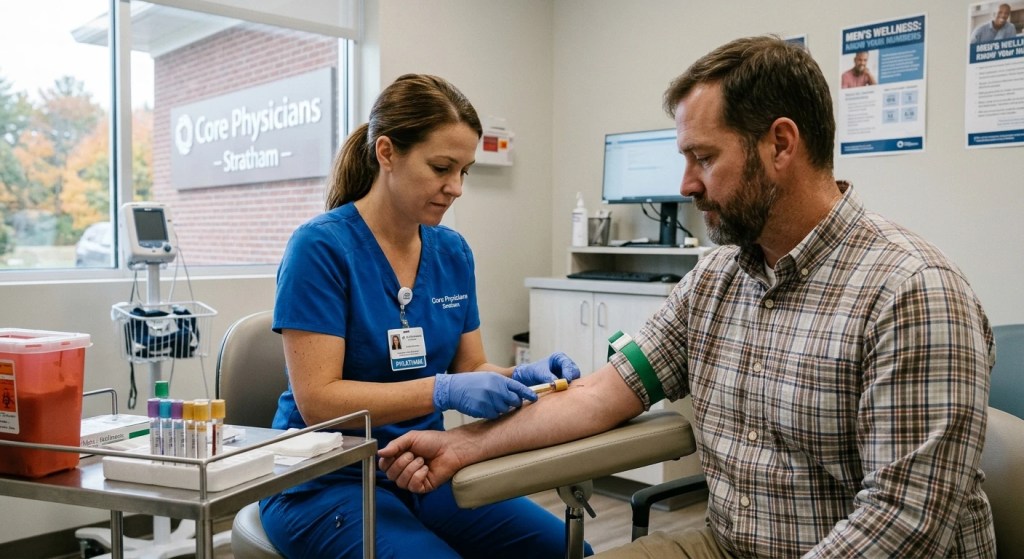
Most men wait until something feels wrong before they get labs done. By then, problems like high blood sugar, rising cholesterol or low testosterone have often been building quietly for years. The right men’s health blood work catches those changes early, while they’re easier to fix.
This guide covers which tests matter, how often to get them at each age, how to prepare, and what gets monitored if you’re on testosterone therapy.
| The short answer: what blood work should men get? Most men benefit from a complete blood count (CBC), a comprehensive metabolic panel (CMP), a lipid panel and a hemoglobin A1c. Add testosterone testing if you have symptoms like low energy or low libido, a thyroid test (TSH) if symptoms point that way, and a PSA conversation from your mid-40s. Men on TRT also need regular testosterone, hematocrit and PSA checks. |
Key Takeaways
- Four core tests cover most of your baseline: CBC, CMP, lipid panel and A1c.
- Testosterone should be tested early in the morning, and low results should be confirmed with a second test.
- PSA screening is a personal decision you make with your provider, usually starting between 45 and 50.
- Vitamin D, iron and thyroid tests are most useful when symptoms or risk factors call for them.
- On TRT, hematocrit and testosterone levels need regular monitoring for safety.
- Fasting, timing and supplements like biotin can change your results, so prep matters.
The Core Men’s Health Blood Work Panel
These four tests form the foundation of blood work for men at almost any age. Together they give a snapshot of your blood, organs, heart risk and blood sugar.
Core blood tests for men
| Test | What it checks | Why it matters for men |
| Complete blood count (CBC) | Red and white blood cells, hemoglobin, hematocrit, platelets | Flags anemia, infection and thick blood. Required before starting TRT. |
| Comprehensive metabolic panel (CMP) | Glucose, kidney function, liver enzymes, electrolytes, protein | Screens kidney and liver health, which many medications and supplements affect |
| Lipid panel | Total cholesterol, LDL, HDL, triglycerides | Heart disease remains a leading health risk for men |
| Hemoglobin A1c | Average blood sugar over about three months | Finds prediabetes before it becomes type 2 diabetes |
Lipid panel: how often?
The CDC says most healthy adults should have their cholesterol checked every 4 to 6 years. Men with heart disease, diabetes or a family history of high cholesterol need it more often (CDC).
A1c: what the numbers mean
The U.S. Preventive Services Task Force (USPSTF) recommends screening adults aged 35 to 70 who are overweight or obese for prediabetes and type 2 diabetes (AAFP). According to the CDC, an A1c below 5.7% is normal, 5.7% to 6.4% means prediabetes, and 6.5% or higher means diabetes (CDC). A result in the prediabetes range should be confirmed with a repeat test.
If your A1c or lipids are creeping up and weight is part of the picture, a supervised medical weight loss plan can help move those numbers in the right direction.
Hormone and Specialty Tests: When They Make Sense
Beyond the core panel, the right men’s blood work depends on your symptoms, age and family history. Here’s when each test earns its place.
Testosterone
The American Urological Association (AUA) uses a total testosterone level below 300 ng/dL as a reasonable cutoff for low testosterone. The diagnosis should be made only after two early-morning measurements on separate days, along with symptoms (AUA guideline summary).
The AUA also suggests checking testosterone in men with certain conditions, even without symptoms. These include unexplained anemia, bone density loss, diabetes, male infertility, and long-term opioid or corticosteroid use.
LH and prolactin
If testosterone comes back low, the AUA recommends measuring luteinizing hormone (LH). If LH is low or low-normal, prolactin should be checked too. These tests help show whether the issue starts in the testes or the pituitary gland.
Thyroid (TSH)
A TSH test is worth adding if you have fatigue, unexplained weight change, feeling cold or low mood. Thyroid problems can mimic low testosterone, so testing both helps avoid the wrong diagnosis.
PSA (prostate-specific antigen)
Under the AUA’s 2023 early detection guideline, providers may offer a baseline PSA between ages 45 and 50. Men at higher risk, including those of Black ancestry, those with a strong family history and those with certain inherited gene mutations, should start at 40 to 45. From 50 to 69, the AUA recommends regular screening every 2 to 4 years, personalized to your results and risk (UroToday).
The USPSTF calls PSA screening for men 55 to 69 an individual decision and recommends against routine screening at 70 and older. Its recommendation is currently being updated (USPSTF).
Vitamin D, iron and B12
These are popular add-ons, but they aren’t needed for everyone. The USPSTF found too little evidence to recommend routine vitamin D screening for adults without symptoms (AAFP). Testing makes more sense if you have fatigue, frequent illness, bone concerns, a restricted diet or a condition that affects absorption.
Men’s Health Blood Work by Age
Your needs change as you get older. Use this table as a starting point for a conversation with your provider, not a fixed schedule.
Blood work for men by age
| Age | Core tests | Discuss with your provider |
| 20s and 30s | CBC and CMP; lipid panel every 4 to 6 years if healthy | Testosterone if you have symptoms; A1c from 35 if overweight |
| 40s | CBC, CMP, lipid panel; A1c if overweight | Baseline PSA from 45 (from 40 if higher risk); testosterone and TSH with symptoms |
| 50s and 60s | CBC, CMP, lipid panel, A1c | PSA every 2 to 4 years; more frequent lipids if risk is rising |
| 70 and older | CBC, CMP, lipid panel, A1c as advised | PSA only after a personal discussion; USPSTF advises against routine screening |
Signs It’s Time to Check Your Hormones
Testosterone tends to decline gradually with age, and the symptoms are easy to blame on stress or getting older. Consider hormone testing if you notice:
- Low sex drive or weaker erections
- Fatigue that sleep doesn’t fix
- Loss of muscle or strength despite training
- More fat around the midsection
- Low mood, irritability or poor focus
- Poor sleep quality
These symptoms have many possible causes. That’s why good men’s health blood work looks at hormones alongside thyroid, blood sugar and blood counts, rather than testosterone alone. Learn more in our guide on whether hormone replacement therapy is right for you.
Blood Work on TRT: What Gets Monitored
If you start testosterone replacement therapy (see our complete guide to TRT), lab work becomes part of your routine. The goal is to keep your levels in a healthy range and catch side effects early.
Common lab monitoring on testosterone therapy
| Test | When | What providers watch for |
| Hemoglobin and hematocrit | Before starting, then at 3 to 6 months | Endocrine Society guidance: hold therapy if hematocrit rises above 54% |
| Total testosterone | At 3 to 6 months, then every 6 to 12 months | Levels in the mid-normal range; dose adjusted as needed |
| PSA | Before starting, then during the first year | A rise of more than 1.4 ng/mL in year one, or a level above 4 ng/mL, calls for a urology review |
| Symptom review | At 3 to 6 months | If levels normalize but symptoms don’t improve, the plan should be reconsidered |
Sources: AUA guideline summary and Endocrine Society guideline summary.
Our bioidentical hormone replacement therapy program for men uses Biote pellets, with lab work before treatment and regular follow-up. Curious about side effects? Read our post on whether TRT causes hair loss.
How to Prepare for Your Blood Draw
- Book an early-morning slot. Testosterone peaks in the morning, and guidelines base the diagnosis on early-morning levels.
- Ask whether to fast. If your panel includes lipids or glucose, you may need to skip food and drinks other than water for 8 to 12 hours (CDC).
- Drink water. Good hydration makes the draw quicker and easier.
- Tell us about supplements, especially biotin. The FDA has warned that biotin can cause falsely high or low results on some tests, including thyroid tests (TCTMD). Ask your provider whether to pause it before your draw.
- Bring a medication list. Steroids, opioids and some other drugs can affect hormone levels.
- Reschedule if you’re sick. Acute illness can temporarily lower testosterone and skew results.
How to Read Your Results
A lab report shows each result next to a reference range. A number inside the range isn’t automatically ideal, and a number just outside it isn’t always a problem. Three things matter more than any single value:
- Your symptoms. Results should be read alongside how you actually feel.
- Repeat tests. Low testosterone and prediabetes should both be confirmed with a second test before treatment.
- Trends over time. A steady climb in A1c or LDL tells you more than one snapshot. Keep copies of every result.
Men’s Health Blood Work in Stratham, NH
At About Face — A Well Labs+ Medspa, we offer in-office concierge lab draws at 64 Portsmouth Ave, Suite 4, in Stratham. There’s no separate trip to an outside lab. Your hormone consultation includes a thorough hormone panel, and our team reviews the results with you and builds a plan around them.
Depending on your results and goals, that plan might include bioidentical hormone replacement therapy, medical weight loss or peptide therapy. Explore all of our wellness services or read about the benefits of medical weight loss programs.
Routine cancer screening, including your PSA decision, is best kept in coordination with your primary care provider. Share your results with them so your care stays connected.
We welcome men from Stratham, Portsmouth, Exeter and across the New Hampshire Seacoast. Meet our team, book a virtual consultation, or call (603) 580-5296.
| Stop guessing about your health. Book your consultation and in-office lab draw at About Face — A Well Labs+ Medspa in Stratham today. |
Frequently Asked Questions
What is included in a men’s health blood panel?
A typical men’s health blood panel includes a CBC, a comprehensive metabolic panel, a lipid panel and a hemoglobin A1c. Testosterone, TSH, PSA, vitamin D and iron are added based on your symptoms, age and risk factors.
How often should men get blood work?
Many men get a CBC and metabolic panel with a yearly checkup. The CDC suggests a cholesterol check every 4 to 6 years for healthy adults, and more often with heart disease, diabetes or a family history. Men on TRT need labs at 3 to 6 months after starting, then every 6 to 12 months.
Do I need to fast before men’s health blood work?
Only for some tests. If your panel includes a lipid panel or fasting glucose, you may need to avoid food and drinks other than water for 8 to 12 hours. Your provider will tell you what applies to your order.
Why should testosterone be tested in the morning?
Testosterone levels are highest in the morning and drop through the day. The AUA recommends diagnosing low testosterone only after two early-morning tests on separate days.
When should men start PSA testing?
The AUA says providers may offer a baseline PSA between ages 45 and 50, or from 40 to 45 for men at higher risk. Regular screening every 2 to 4 years is recommended from 50 to 69. It’s a personal decision to make with your provider.
What labs are monitored on TRT?
The main ones are hematocrit, total testosterone and PSA. Endocrine Society guidance calls for checks at 3 to 6 months after starting, and holding therapy if hematocrit rises above 54%.
Can supplements affect my blood test results?
Yes. Biotin, common in hair and nail supplements, can cause falsely high or low results on some lab tests, including thyroid tests. Tell your provider about every supplement you take before your blood draw.