
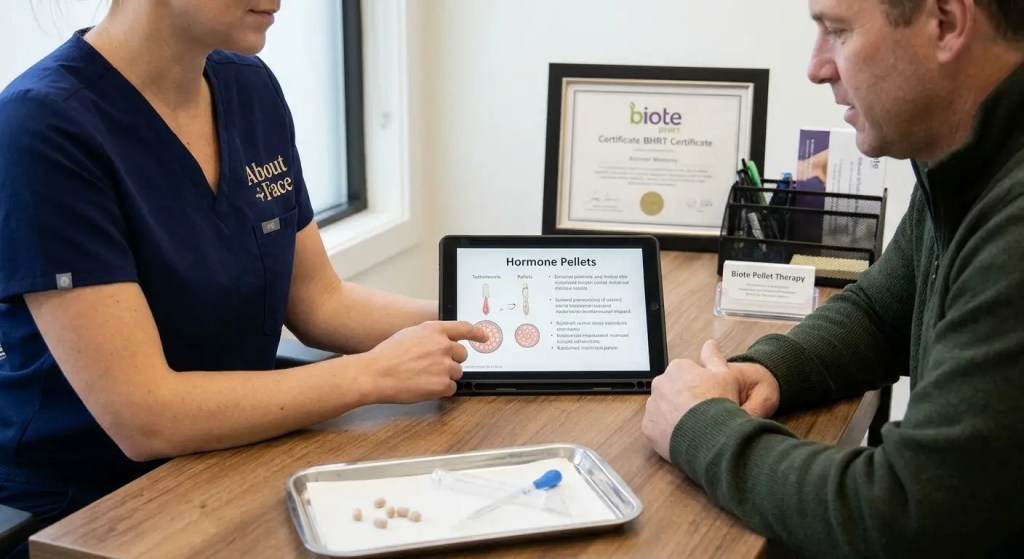
Weekly shots and daily gels aren’t for everyone. Testosterone pellets offer a different approach: a quick in-office visit a few times a year, with no routine to remember in between. But they also come with trade-offs you should understand before you choose them.
This guide explains how testosterone pellets work, what the insertion is like, the real benefits and risks, the difference between FDA-approved and compounded pellets, and who they suit best.
| The short answer: what are testosterone pellets? Testosterone pellets are tiny cylinders of testosterone, about the size of a grain of rice, placed under the skin of the hip or buttock during a short in-office procedure. They dissolve slowly and release testosterone for about 3 to 6 months. Benefits include no daily or weekly dosing and steadier levels than injections. Risks include pellets working their way out, minor infection, higher red blood cell counts, and the fact that a dose can’t easily be reduced once placed. |
Key Takeaways
- Pellets are one form of testosterone replacement therapy (TRT), not a separate treatment.
- An FDA-approved pellet exists, and many clinics also use compounded pellets, which aren’t FDA-approved.
- Each insertion typically lasts about 3 to 6 months.
- Pellets raised hematocrit less often than injections, but more often than gels, in one comparison study.
- Pellet extrusion, bruising and infection at the insertion site are the main procedure risks.
- Like any TRT, pellets require confirmed low testosterone and regular labs.
How Do Testosterone Pellets Work?
Each pellet is a small, solid cylinder of compressed testosterone. Once it sits under the skin, the body slowly absorbs it, releasing hormone into the bloodstream over months. Levels rise in the weeks after insertion, then gradually taper as the pellets dissolve.
The FDA-approved pellet, Testopel, contains 75 mg of testosterone per pellet. Its label lists a dose of 150 to 450 mg (2 to 6 pellets) every 3 to 6 months, and notes the effect usually lasts 3 to 4 months, sometimes up to 6 (Testopel label).
Pellets are simply one way of delivering testosterone replacement therapy. For the bigger picture, read what is TRT?
FDA-Approved vs. Compounded Pellets
This is one of the most important things to understand, and many clinics don’t explain it.
- FDA-approved pellets (Testopel) have gone through FDA review for safety, effectiveness and manufacturing quality, and are approved for men with low testosterone.
- Compounded pellets are custom-made by compounding pharmacies, often combining doses tailored to the patient. They are not FDA-approved, so FDA has not reviewed them for safety, effectiveness or consistency.
A 2020 report from the National Academies of Sciences, Engineering, and Medicine found that the evidence doesn’t support the clinical utility of compounded bioidentical hormone therapy across doses and dosage forms. It recommended reserving compounded hormones for patients who can’t use an FDA-approved product, and fully explaining the risks to those who use them (RAPS).
At About Face, our bioidentical hormone replacement therapy program uses Biote pellets, which are compounded. We believe you should know that, along with your other options, so you can make an informed choice.
What Happens During Pellet Insertion?
The procedure is quick and done in the office. While details vary by provider, it typically goes like this:
- Labs first. Low testosterone is confirmed with blood tests, and your provider uses your results to choose the dose.
- Numbing. The skin of the upper hip or buttock is cleaned and numbed with a local anesthetic.
- Insertion. A tiny incision is made, and the pellets are placed under the skin with a small instrument.
- Closing. The incision is closed with adhesive strips and covered with a bandage. No stitches are usually needed.
The whole visit usually takes less than an hour. Most people return to normal daily activities the same day.
Aftercare
Activity limits matter, because pressure and friction can push pellets out. Our current aftercare guidance asks men to avoid strenuous physical activity and submerging in water, such as baths, hot tubs or swimming, for 7 days after insertion. Women follow the same guidance for 3 days (About Face BHRT). Call your provider if you notice increasing redness, warmth, pus, fever or a pellet coming through the skin.
Benefits of Pellet Therapy
- Convenience. A few visits a year, with no shots, daily gels or pills.
- No skin transfer. Unlike gels, pellets can’t rub off onto a partner or child.
- Gradual release. Levels don’t swing as sharply as with injections given every few weeks.
- Fewer blood count spikes than injections. In a 2015 study, hematocrit rose above 50% in 35.1% of men on pellets, compared with 66.7% on injections and 12.8% on gels (Sexual Medicine).
- All the general benefits of TRT for men with confirmed low T, such as improved sexual function, mood and bone density.
Risks and Side Effects of Testosterone Pellets
Procedure-related risks
- Pellet extrusion, when a pellet works its way out through the skin
- Infection at the insertion site
- Bruising, bleeding or soreness for a few days
How common are these? A large retrospective study of more than 1.2 million Biote pellet insertions reported complications in 0.785% of procedures, with extrusion in under 3% of men. That study was self-reported by practitioners and authored by Biote’s founder, so independent data would be valuable (Biote press release).
Hormone-related risks
Pellets carry the same hormone risks as any testosterone therapy:
- Higher hematocrit (thicker blood). Endocrine Society guidance calls for holding therapy if it rises above 54% (MDedge).
- Higher blood pressure, now a class-wide warning on all testosterone products (FDA).
- Lower sperm production and smaller testes (Healio).
- Acne, oily skin and possible hair thinning in men prone to it. See does TRT cause hair loss?
- Heart rhythm and clot risks. In the 2023 TRAVERSE trial, testosterone didn’t raise heart attack or stroke rates, but atrial fibrillation and pulmonary embolism were somewhat more common (TCTMD).
The dosing trade-off
Pellets can’t be easily removed or adjusted once they’re in. If your levels run too high or you have side effects, you generally have to wait for the pellets to dissolve. Injections and gels, by contrast, can be changed from one dose to the next. That’s why accurate labs and conservative dosing matter so much.
Pellets vs. Injections vs. Gels
How pellets compare with other TRT forms
| Pellets | Injections | Gels | |
| How often | Every 3 to 6 months | Weekly to every few weeks (one type every 10 weeks) | Daily |
| Hormone pattern | Gradual rise, then slow taper | Peaks after each shot, then falls | Steadier day to day |
| Hematocrit above 50% (2015 study) | 35.1% | 66.7% | 12.8% |
| Easy to adjust dose? | No, must wait for pellets to dissolve | Yes | Yes |
| Main drawbacks | Minor procedure; extrusion; infection | Needles; peaks and dips | Daily routine; skin transfer |
Considering shots instead? Read our injectable testosterone beginner’s guide.
Testosterone Pellets for Women
Women need testosterone too, at much lower levels than men. The 2019 Global Consensus Position Statement found that testosterone doses keeping women’s levels in the normal premenopausal range weren’t linked to hair loss, though some women noticed mild acne or extra hair. It also recommended against higher-than-physiologic doses and against compounded products where approved options exist (Climacteric).
A study presented at the 2021 ACOG meeting found that women using hormone pellets had much higher peak hormone levels than women on conventional therapy (MDedge). If you’re a woman considering pellets, ask how your dose is chosen and how often your levels will be checked. Learn more about our hormone therapy for women.
Who Are Pellets Best For?
Pellets can be a good fit if you:
- Have confirmed low testosterone and symptoms
- Want to avoid frequent injections or daily gels
- Live with a partner or young children and want to avoid skin transfer
- Have stable levels on testosterone and don’t need frequent dose changes
They may not be the best choice if you want to have children soon, need flexible dose changes, have a history of skin infections, or can’t limit strenuous activity for a week after insertion.
Monitoring on Pellet Therapy
Pellets don’t mean fewer labs. Before starting, low testosterone should be confirmed with two early-morning tests below about 300 ng/dL (AUA guideline summary). After that, expect regular checks of testosterone, hematocrit, blood pressure and, when appropriate, PSA. Testing before each new insertion helps your provider choose the right dose. Our guide to men’s health blood work explains these tests.
Testosterone Pellets in Stratham, NH
At About Face — A Well Labs+ Medspa, pellet therapy starts with your symptoms, health history and a thorough hormone panel, with in-office concierge lab draws at 64 Portsmouth Ave, Suite 4. If pellets are a good fit, we place them in a quick in-office visit and monitor your levels over time. Biote pellets typically last three to five months.
Not sure you have low T? Start with low testosterone symptoms men often ignore. We welcome patients from Stratham, Portsmouth, Exeter and across the New Hampshire Seacoast. Meet our team, book a virtual consultation, or call (603) 580-5296.

| Wondering if testosterone pellets are right for you? Book your hormone consultation and in-office lab draw at About Face — A Well Labs+ Medspa in Stratham today. |
Frequently Asked Questions
How long do testosterone pellets last?
Usually about 3 to 6 months. The FDA-approved pellet’s label says effects typically last 3 to 4 months and sometimes up to 6. Timing depends on your dose and how quickly your body absorbs the pellets.
Does pellet insertion hurt?
The skin is numbed first, so most people feel pressure rather than pain. Mild soreness or bruising for a few days afterward is common.
Are testosterone pellets FDA-approved?
One testosterone pellet product, Testopel, is FDA-approved for men. Many clinics use compounded pellets, which are made by compounding pharmacies and are not FDA-approved. Ask your provider which type you’re getting.
Are testosterone pellets better than injections?
Neither is better for everyone. Pellets mean fewer visits and steadier levels, and in one study they raised hematocrit less often than injections. Injections are easier to adjust and don’t require a procedure.
What happens if a pellet comes out?
Extrusion is one of the most common pellet complications. Contact your provider, keep the area clean, and watch for signs of infection. Your dose may need to be reviewed.
Can I exercise after pellet insertion?
You’ll need to avoid strenuous activity and soaking in water for several days. At About Face, men follow this for 7 days and women for 3 days after insertion.
Do pellets affect fertility?
Yes. Like all testosterone therapy, pellets can reduce sperm production. If you want children, discuss fertility-preserving options before starting.