
If your provider has mentioned testosterone injections, you probably have questions. How often? Does it hurt? Can you do it at home? What do the labs mean? This beginner’s guide walks you through injectable testosterone from your first blood test to long-term monitoring, in plain language.
| The short answer: what is injectable testosterone? Injectable testosterone is a prescription form of testosterone replacement therapy (TRT) for men with confirmed low testosterone. The most common types, testosterone cypionate and enanthate, are injected into a muscle. Other options include a weekly under-the-skin autoinjector and a long-acting shot given in a clinic every 10 weeks. Injections work reliably, but levels rise and fall between doses, and regular labs are essential. |
Key Takeaways
- Injectable testosterone is a Schedule III controlled substance available only by prescription.
- Low testosterone must be confirmed with morning blood tests on at least two separate days before starting.
- Shots come in several types, from weekly self-injections to clinic-only doses every 10 weeks.
- Injections raise red blood cell counts more often than gels or pellets, so blood counts need monitoring.
- Testosterone therapy can reduce sperm production. Talk about fertility first.
- Never buy testosterone online or from a gym. Only use a licensed pharmacy.
What Is Injectable Testosterone?
Testosterone on its own breaks down too quickly to be useful as a shot. So injectable testosterone is attached to a fatty acid chain, called an ester, and dissolved in oil. The ester lets the hormone release slowly from the injection site over days or weeks.
Testosterone is a Schedule III controlled substance. Every product label requires low testosterone to be confirmed first, with morning blood tests on at least two separate days that both fall below the normal range (testosterone cypionate label).
Not sure if your levels are truly low? Start with our complete guide to TRT, our guide to men’s health blood work and our comparison of low testosterone treatment options.
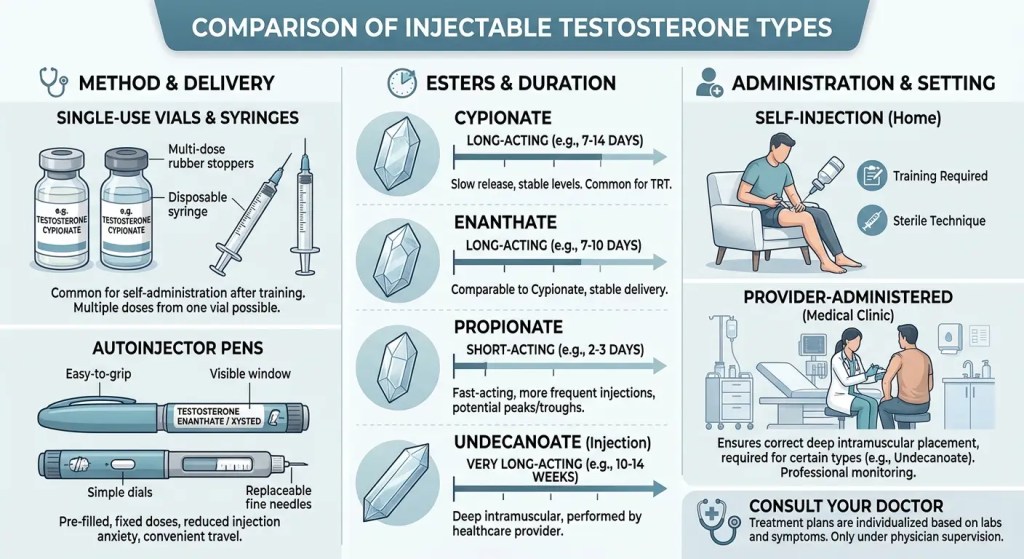
Types of Injectable Testosterone
The main injectable testosterone options
| Type | How it’s given | How often | Good to know |
| Testosterone cypionate | Into a muscle | Label range: every 2 to 4 weeks; your provider sets the schedule | Widely prescribed; available as a generic |
| Testosterone enanthate (vial) | Into a muscle | Similar to cypionate | Works much like cypionate; also generic |
| Xyosted (testosterone enanthate autoinjector) | Under the skin of the belly, with a prefilled pen | Once a week | Carries a boxed warning about raising blood pressure |
| Aveed (testosterone undecanoate) | Deep muscle shot given only in a certified clinic | At start, at 4 weeks, then every 10 weeks | 30-minute observation after each shot because of rare serious reactions |
Sources: testosterone cypionate label, Xyosted label, Aveed prescribing information.
Muscle vs. under the skin
Cypionate labels call for a deep injection into the buttock muscle. Xyosted is designed for the belly, at least 2 inches from the navel, and shouldn’t be injected into a muscle (Xyosted label). Your provider will tell you which method your prescription uses and train you before your first home injection.
Injections vs. Gels vs. Pellets
Injections are only one way to take testosterone. Each form has trade-offs:
Comparing common TRT forms
| Injections | Gels and creams | Pellets | |
| How often | Weekly to every 10 weeks, by type | Daily | Every few months |
| Hormone levels | Rise after each shot, then fall | Steadier day to day | Released gradually |
| Hematocrit above 50% in one study | 66.7% | 12.8% | 35.1% |
| Main drawback | Peaks and dips; needles | Daily routine; can rub off on others | Minor in-office procedure each time |
The hematocrit figures come from a 2015 study in Sexual Medicine comparing men on each form. Hematocrit measures how thick your blood is, and injections raised it most often (Sexual Medicine).
Before Your First Injection
- Confirm low T. Two early-morning tests on different days, plus symptoms. The American Urological Association uses 300 ng/dL as a reasonable cutoff (AUA guideline summary).
- Get baseline labs. Hemoglobin and hematocrit are checked before starting, and many men also need a PSA, depending on age and risk.
- Talk about fertility. Testosterone from outside the body tells the testes to slow down, which can reduce or stop sperm production (Healio). If you want children, discuss fertility-preserving options first.
- Review your heart health and blood pressure. All testosterone products now carry a class-wide warning about blood pressure increases (FDA).
- Learn the technique in person. Your first injection should be done with, or taught by, a trained provider.
How a Testosterone Injection Works Day to Day
Your provider will teach you the exact steps for your product. Every injection should follow the same basic safety rules:
- Wash your hands and clean the injection site with an alcohol swab.
- Use a new, sterile needle and syringe every time. Never share or reuse them.
- Check the medication. If crystals form in a cold vial of cypionate, warming and shaking it should dissolve them (label).
- Rotate injection sites to reduce soreness.
- Drop used needles straight into an FDA-cleared sharps container (FDA).
Mild soreness at the injection site for a day or two is common. Redness that spreads, heat, swelling or fever needs a call to your provider.
Peaks, Troughs and Why Lab Timing Matters
With injectable testosterone, levels climb after each shot and then drift down until the next one. Some men notice energy, mood or libido dipping before their next dose. If that happens, your provider may adjust the dose or how often you inject.
Because levels move, the timing of your blood draw matters. For example, Xyosted’s label calls for a trough level 7 days after a dose, at 6 weeks and after each dose change. A trough of 350 to 650 ng/dL is the target range on that product (Xyosted label). The Endocrine Society recommends keeping levels in the mid-normal range for healthy young men (MDedge).
Side Effects and Safety
- Thicker blood (high hematocrit). The most common lab issue with injections. Endocrine Society guidance calls for holding therapy if hematocrit rises above 54% (MDedge).
- Higher blood pressure. Now a labeled risk for all testosterone products.
- Lower sperm count and smaller testes, because your body makes less of its own testosterone.
- Acne and oily skin, especially at higher levels.
- Heart rhythm and clots. In the 2023 TRAVERSE trial of 5,246 men, testosterone didn’t raise heart attack or stroke rates, but atrial fibrillation (3.5% vs. 2.4%) and pulmonary embolism (0.9% vs. 0.5%) were more common (TCTMD).
- Hair thinning in men prone to male pattern baldness. Read more in does TRT cause hair loss?
Aveed has its own boxed warning for rare but serious reactions right after the shot, including a lung reaction from oil droplets and anaphylaxis. That’s why it’s only given in certified clinics with a 30-minute observation period (Aveed).
Your Monitoring Schedule
Typical lab and check-in schedule
| When | What’s checked |
| Before starting | Two morning testosterone tests, hemoglobin and hematocrit, PSA when appropriate |
| About 6 weeks (autoinjector) or 3 to 6 months | Testosterone level, hematocrit, blood pressure and symptom review |
| Every 6 to 12 months | Testosterone level, as recommended by the AUA, plus hematocrit |
| During the first year | PSA: a rise of more than 1.4 ng/mL, or a level above 4 ng/mL, calls for a urology review |
Sources: AUA guideline summary, Endocrine Society summary, Xyosted label.
Storage, Travel and Disposal
- Storage. Keep testosterone cypionate at room temperature, 68°F to 77°F, protected from light (label).
- Security. As a controlled substance, keep it out of reach of others and never share it.
- Travel. Keep it in its labeled pharmacy packaging and bring a copy of your prescription.
- Disposal. Use an FDA-cleared sharps container, and follow your local rules when it’s full (FDA).
Common Beginner Mistakes to Avoid
- Buying testosterone online or at the gym. Gray-market products can be counterfeit or contaminated. FDA has warned that some bodybuilding products contain hidden steroids that can cause liver injury, heart attack and stroke (FDA).
- Chasing a high number. The goal is a healthy range and feeling better, not the highest possible level.
- Skipping follow-up labs. High hematocrit and blood pressure don’t cause symptoms early on.
- Changing your dose yourself. Adjustments should come from your provider, based on labs.
- Stopping suddenly. Low testosterone symptoms usually return. Plan any changes with your provider.
Injections or Pellets? Testosterone Therapy in Stratham, NH
Injectable testosterone is a good fit for many men, but it isn’t the only option. At About Face — A Well Labs+ Medspa, our bioidentical hormone replacement therapy program uses Biote pellets, which are placed under the skin and release hormones gradually over about three to five months. That means no weekly shots to remember. Compare the options in our testosterone pellets guide.
Every plan starts with a consultation and a thorough hormone panel, drawn right in our office with in-office concierge lab draws. We’ll walk you through how injections and pellets compare for your lifestyle, health history and goals. Women considering testosterone can learn about our hormone therapy for women.
We welcome patients from Stratham, Portsmouth, Exeter and across the New Hampshire Seacoast at 64 Portsmouth Ave, Suite 4. Meet our team, book a virtual consultation, or call (603) 580-5296.

| Wondering whether shots or pellets are right for you? Book your hormone consultation and in-office lab draw at About Face — A Well Labs+ Medspa in Stratham today. |
Frequently Asked Questions
How often do you inject testosterone?
It depends on the product. Testosterone cypionate labels list a range of every 2 to 4 weeks, and providers often tailor the schedule to smooth out levels. Xyosted is injected once a week, and Aveed is given at the start, at 4 weeks, then every 10 weeks.
Do testosterone injections hurt?
Most people feel a quick pinch and some muscle soreness for a day or two. Proper technique, rotating sites and letting the medication reach room temperature can make injections more comfortable.
Can I give myself shots at home?
Yes, many men self-inject after hands-on training from their provider. Aveed is the exception: it must be given in a certified clinic.
How long does injectable testosterone take to work?
Many men notice changes in energy and mood within a few weeks. Benefits for libido, body composition and strength usually take longer. Your provider reviews symptoms and labs around 3 to 6 months.
Is injectable testosterone better than pellets?
Neither is better for everyone. Injections allow quick dose changes, while pellets avoid frequent shots and release hormone gradually. In one study, injections raised hematocrit more often than pellets or gels.
Will testosterone injections affect my fertility?
They can. Testosterone therapy can reduce or stop sperm production. If you may want children, talk to your provider about fertility-preserving options before starting.
Is it legal to buy injectable testosterone online?
Only with a valid prescription filled by a licensed pharmacy. Testosterone is a Schedule III controlled substance, and products sold without a prescription can be counterfeit or contaminated.